
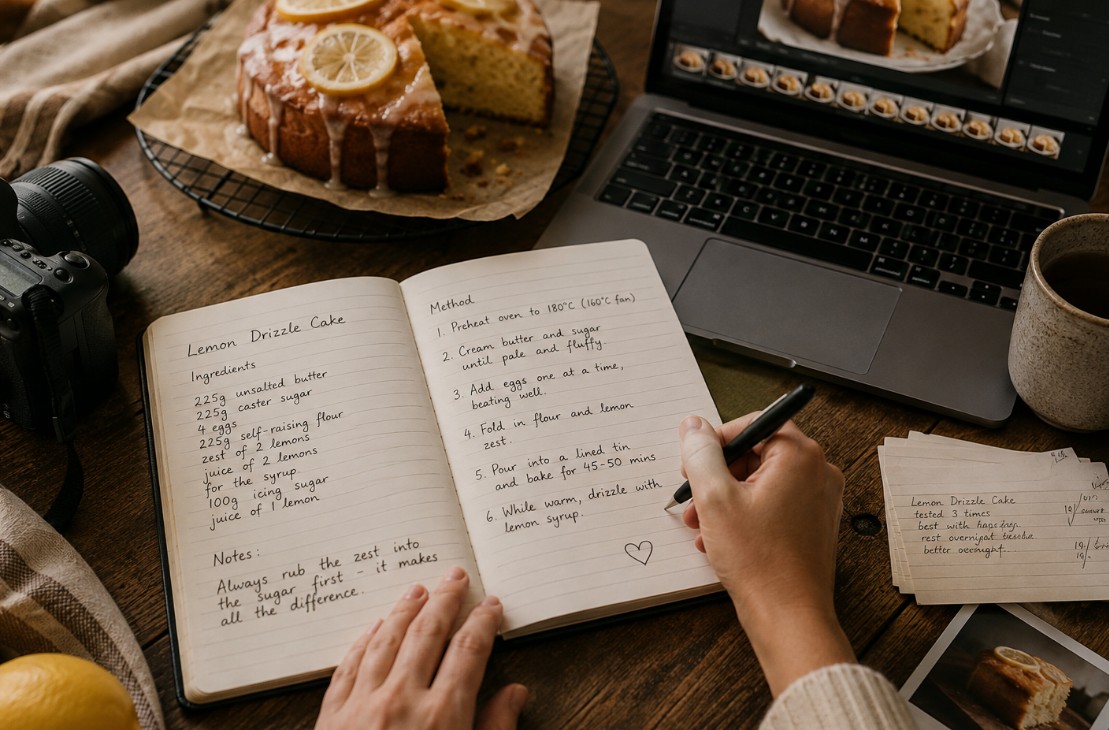
You publish a lemon cake recipe after weeks of testing. A month later, another site runs a suspiciously familiar version, complete with your note about rubbing the zest into the sugar first. A plagiarism checker can help find copied wording, but it cannot decide who legally owns a recipe.
For home cooks, the best approach is a mix of exact-phrase searches, dedicated plagiarism tools, image searches, and good recordkeeping.
Under U.S. copyright guidance, a simple ingredient list is generally outside copyright protection, while original explanatory prose, photographs, and sufficiently creative written directions may qualify. Plagiarism and copyright infringement therefore overlap, but they are not identical.
Recipe copying is trickier than copying an article
Recipes occupy an awkward corner of copyright law because cooking depends on functional information. A list calling for flour, eggs, sugar, and salt tells someone what to use. Basic steps such as “mix,” “bake,” or “cool” can be functional as well.
The U.S. Copyright Office states that a mere listing of ingredients is not protected. A recipe accompanied by substantial literary expression, such as creative explanations or directions, may have protectable elements. A cookbook can also contain copyrightable text, photographs, artwork, and original arrangement.
Picture two bloggers making tomato soup. Both may use tomatoes, onion, garlic, stock, and cream. Similar ingredients alone prove little.
If one copies another writer’s personal introduction, distinctive troubleshooting notes, serving description, and photographs, the evidence looks much stronger.
What can plagiarism detection tools actually find?
Plagiarism software compares submitted text with material available in its searchable sources. Depending on the service, it may flag exact matches, near matches, reordered language, or paraphrased passages.
Results still need human review. Recipe writing naturally repeats phrases such as “preheat the oven,” “season to taste,” and “stir until combined.” A similarity score can become noisy when most matches come from ordinary cooking language.
Distinctive passages matter more. A sentence describing why brown butter should smell “like toasted hazelnuts before the milk solids darken” is far more useful for comparison than “add butter to the pan.”
For occasional checking, search engines work surprisingly well. Put an unusual eight-to-twelve-word sentence from your recipe inside quotation marks and search it. Repeat with two or three passages from different sections. Exact matches on unrelated sites deserve a closer look.
Which plagiarism tools are useful for recipe writers?
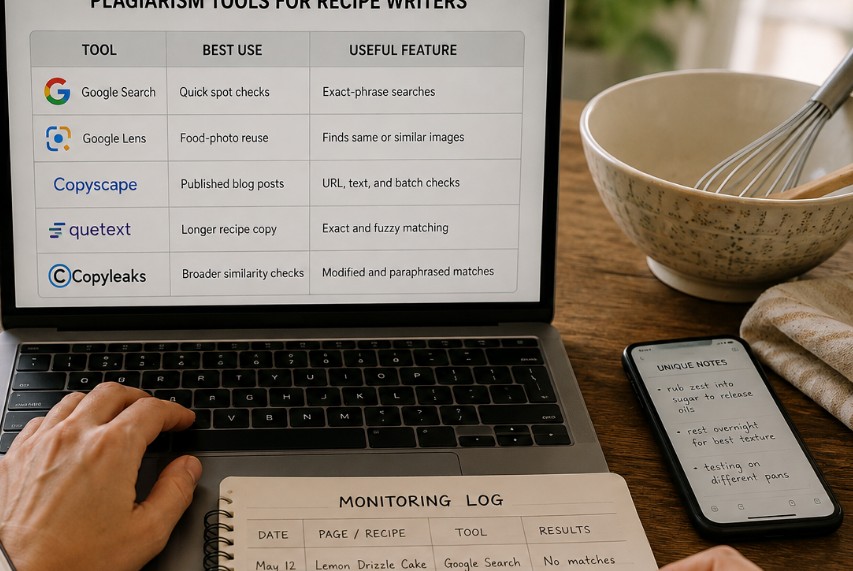
No single service covers every corner of the web. A small toolkit usually works better than relying on one similarity score.
For another point of comparison, you can run distinctive passages through a plagiarism checker and compare its findings with results from other tools.
| Tool | Best use | Useful feature |
| Google Search | Quick spot checks | Exact-phrase searches |
| Google Lens | Food-photo reuse | Finds same or similar images |
| Copyscape Premium | Published blog posts | URL, text, and batch checks |
| Quetext | Longer recipe copy | Exact and fuzzy matching |
| Copyleaks | Broader similarity checks | Modified and paraphrased matches |
Google Lens can return websites containing the same or a similar image, making it useful when a copied recipe also carries your plated-dish photograph.
Copyscape Premium accepts pasted text, documents, and URLs. Its current listed price is 3 cents per search for up to 200 words, plus 1 cent for each additional 100 words or part of 100. Batch Search can scan up to 10,000 pages in one operation.
Quetext says its free checker handles up to 1,000 words without sign-up and uses contextual analysis plus fuzzy matching to identify exact and near matches. Copyleaks separates identical text, minor changes, and paraphrased material in its similarity reports. Vendor claims about database size or accuracy deserve the same caution as any marketing claim.
Build a simple monitoring routine
A home cook with twenty recipes does not need an enterprise copyright operation. Start with recipes that carry the most original writing or attract the most traffic.
Search a few distinctive sentences in quotation marks. Run important pages through a plagiarism checker. Search your strongest food photographs with Google Lens. Keep a short log containing the copied URL, discovery date, screenshots, and any messages you send.
Preserve your own creation history too. Draft files, camera originals, editing history, recipe-testing notes, and publication dates can help establish a timeline.
A copyright notice can communicate ownership, although eligible material generally receives U.S. copyright protection when original expression is fixed in a tangible form, such as written text or a saved photograph, according to Copyright Office guidance for writers.
What should you do after finding a copied recipe?
Save evidence before contacting anyone. Take screenshots, record the page URL, note the date, and save a copy of the copied material. Pages can disappear quickly after a complaint.
Next, compare protectable expression rather than ingredients alone. Look for copied paragraphs, distinctive directions, headnotes, photographs, illustrations, or a substantial combination of original material.
A polite direct request often resolves smaller cases. Identify your original page, point to the copied material, and ask for removal, correction, licensing, or attribution, depending on your goal.
For material hosted by an online service provider, U.S. law includes a notice-and-takedown process under Section 512. The Copyright Office explains that a valid takedown notice generally identifies the copyrighted work and allegedly infringing material, provides contact details, includes required good-faith and accuracy statements, and carries a physical or electronic signature. Registration is not required before sending a takedown notice.
Registration matters more if a dispute may escalate. For U.S. works, registration is generally required before filing an infringement suit in federal court. Timely registration can also affect access to statutory damages and attorney’s fees under U.S. copyright registration rules.
For smaller disputes, the Copyright Claims Board offers a voluntary alternative to federal court for certain claims involving up to $30,000. Copyright rules vary by country, so creators outside the United States should check local law before relying on U.S. procedures.
Protect the parts that carry your voice
A recipe can travel widely without anyone stealing it. Home cooks often arrive at similar ratios, temperatures, and techniques because food chemistry nudges them in the same direction.
Your strongest evidence usually lives in the expressive layer around the formula: original explanations, testing notes, photographs, troubleshooting advice, personal observations, and memorable wording.
Plagiarism detection tools help locate suspicious reuse, especially when paired with exact-phrase searches and image matching. Keep dated records, monitor valuable pages, and judge matches carefully.
A copied tablespoon measurement may mean nothing. A copied paragraph explaining why your grandmother always rested the dough overnight tells a very different story.